

|
|
|
Codec Engine Application Programming Interface (API)
ce-w08
|
Defines the fields and methods that must be supplied by all XDAIS algorithms. More...
#include <ialg.h>
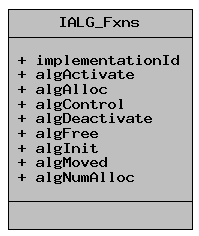
Data Fields | |
| Void * | implementationId |
| Unique pointer that identifies the module implementing this interface. | |
| Void(* | algActivate )(IALG_Handle handle) |
| Notification to the algorithm that its memory is "active" and algorithm processing methods may be called. | |
| Int(* | algAlloc )(const IALG_Params *params, struct IALG_Fxns **parentFxns, IALG_MemRec *memTab) |
| Apps call this to query the algorithm about its memory requirements. Must be non-NULL. | |
| Int(* | algControl )(IALG_Handle handle, IALG_Cmd cmd, IALG_Status *status) |
| Algorithm specific control and status. | |
| Void(* | algDeactivate )(IALG_Handle handle) |
| Save all persistent data to non-scratch memory. | |
| Int(* | algFree )(IALG_Handle handle, IALG_MemRec *memTab) |
| Apps call this to allow the algorithm to initialize memory requested via algAlloc(). Must be non-NULL. | |
| Int(* | algInit )(IALG_Handle handle, const IALG_MemRec *memTab, IALG_Handle parent, const IALG_Params *params) |
| Initialize an algorithm's instance object. Must be non-NULL. | |
| Void(* | algMoved )(IALG_Handle handle, const IALG_MemRec *memTab, IALG_Handle parent, const IALG_Params *params) |
| Notify algorithm instance that instance memory has been relocated. | |
| Int(* | algNumAlloc )(Void) |
| Number of memory allocation requests required. | |
Defines the fields and methods that must be supplied by all XDAIS algorithms.
| Void* IALG_Fxns::implementationId |
Unique pointer that identifies the module implementing this interface.
| Void(* IALG_Fxns::algActivate)(IALG_Handle handle) |
Notification to the algorithm that its memory is "active" and algorithm processing methods may be called.
| [in] | handle | Handle to an algorithm instance. |
NULL. This is equivalent to the following implementation: handle must be a valid handle for the algorithm's instance object.| Int(* IALG_Fxns::algAlloc)(const IALG_Params *params, struct IALG_Fxns **parentFxns, IALG_MemRec *memTab) |
Apps call this to query the algorithm about its memory requirements. Must be non-NULL.
| [in] | params | Algorithm specific attributes. |
| [out] | parentFxns | Parent algorithm functions. |
| [out] | memTab | array of memory records. |
NULL; however, in this case, algAlloc() must assume default creation parameters and must not fail.memTab[] is no less than the number returned by algNumAlloc().*parentFxns is a valid pointer to an IALG_Fxns pointer variable.*parentFxns is set to a non-NULL value that points to a valid IALG_Fxns structure, the parent's IALG implementation. Otherwise, this pointer is not set. algAlloc() may elect to ignore the parentFxns pointer altogether.NULL, thereby requiring the memory for the buffer to be provided by the client.n elements of the memTab[] array are initialized, where n is the return value from this operation.memTab with an IALG_PERSIST or IALG_SCRATCH attribute, the algorithm does not set its base field.memTab[0] defines the memory required for the instance's object and this object's first field is an IALG_Obj structure.memTab[0] is requested as persistent memory.| Int(* IALG_Fxns::algControl)(IALG_Handle handle, IALG_Cmd cmd, IALG_Status *status) |
Algorithm specific control and status.
| [in] | handle | Algorithm instance handle. |
| [in] | cmd | Algorithm specific command. |
| [out] | status | Algorithm specific status. |
cmd, and an input/output status buffer pointer to an algorithm's instance object.NULL. This is equivalent to the following implementation: handle must be a valid handle for the algorithm's instance object.cmd values are always less than IALG_SYSCMD.cmd value is not recognized by the algorithm, the return value is not equal to IALG_EOK.| Void(* IALG_Fxns::algDeactivate)(IALG_Handle handle) |
Save all persistent data to non-scratch memory.
| [in] | handle | Algorithm instance handle. |
handle is used by the algorithm to identify the various buffers that must be saved prior to the next cycle of algActivate() and processing.NULL. This is equivalent to the following implementation: handle must be a valid handle for the algorithm's instance object.| Int(* IALG_Fxns::algFree)(IALG_Handle handle, IALG_MemRec *memTab) |
Apps call this to allow the algorithm to initialize memory requested via algAlloc(). Must be non-NULL.
| [in] | handle | Algorithm instance handle. |
| [out] | memTab | Output array of memory records. |
handle. This function always returns a positive non-zero value indicating the number of records initialized. This function can never initialize more memory records than the value returned by algNumAlloc().memTab[] array contains at least algNumAlloc() records.handle must be a valid handle for the algorithm's instance object.memTab[] contains pointers to all of the memory passed to the algorithm via algInit().| Int(* IALG_Fxns::algInit)(IALG_Handle handle, const IALG_MemRec *memTab, IALG_Handle parent, const IALG_Params *params) |
Initialize an algorithm's instance object. Must be non-NULL.
@param[in]  handle          Algorithm instance handle.  This is a pointer
                            to an initialized IALG_Obj structure.  Its
                            value is identical to the
                            <tt>memTab[0].base</tt>.
@param[in]  memTab          Array of allocated buffers.
@param[in]  parent          Handle of algorithm's parent instance.
@param[in]  params          Pointer to algorithm's instance parameters.

@remarks    algInit() performs all initialization necessary to complete the
            run-time creation of an algorithm's instance object.  After a
            successful return from algInit(), the algorithm's instance
            object is ready to be used to process data.

@remarks    @c handle is a pointer to an initialized IALG_Obj structure.
            Its value is identical to the <tt>memTab[0].base</tt>.

@remarks    @c memTab is a table of memory records that describe the
            base address, size, alignment, type, and memory space
            of all buffers allocated for an algorithm instance
            (including the algorithm's instance object itself).  The
            number of initialized records is identical to the
            number returned by a prior call to algAlloc().

@remarks    @c parent is a handle to another algorithm instance object.
            This parameter is often NULL; indicating that no
            parent object exists.  This parameter allows clients
            to create a shared algorithm instance object and pass
            it to other algorithm instances.  For example, a
            parent instance object might contain global read-only
            tables that are used by several instances of a
            vocoder.

@remarks    @c params is a pointer to algorithm-specific parameters that
            are necessary for the creation and initialization of
            the instance object.  This pointer points to the same
            parameters passed to the algAlloc() operation.
            However, this pointer may be NULL.  In this case,
            algInit(), must assume default creation parameters.

@remarks    Algorithms are encouraged to return (and document!) clear,
            algorithm-specific error codes from algInit().  Create-time
            failures are a common integration issue, and the clearer a
            return value, the sooner the algorithm integrator can identify
            and resolve the issue.

@remarks    The algorithm <b>must not</b> access any scratch resources,
            memory or otherwise, until it has been activated (see
            algActivate()).  A common error is to initialize
            scratch resources during algInit().  This is an error
            as <i>another</i> algorithm, or instance of the same
            algorithm, may be active when this instance's
            algInit() is called.  This algorithm must not access
            scratch resources until it is active.

@remarks    The client is not required to satisfy the IALG_MemSpace
            attribute of the requested memory.  Note however that
            C6000 algorithms that use DMA may strictly require the
            client to satisfy its on-chip memory requirements and
            may not function correctly otherwise.

@remarks    The client may allocate the requested #IALG_WRITEONCE
            buffers once (or never, if the algorithm has assigned
            a base address in the prior call to algAlloc) and use
            the same buffers to initialize multiple instances of
            the same algorithm that are created with identical
            parameters.

@par Example:

@code
    typedef struct EncoderObj {
        IALG_Obj ialgObj;
        int workBuf;
        Int workBufLen;
        ... ;
    } EncoderObj;

    Int algInit(IALG_Handle handle, IALG_MemRec memTab[],
            IALG_Handle parent, IALG_Params *params)
    {
        EncoderObj *inst = (EncoderObj *)handle;
        EncoderParams *encParams = (EncoderParams *)params;

        if (encParams == NULL) {
            encParams = MYDEFAULTPARAMS;
        }

        if (IALG_isOffChip(memTab[1].space)) {
            // unsupported off-chip memory, return documented error code
            return (MYMOD_MYVENDOR_EUNSUPPORTEDOFFCHIPWORKBUF);
        }

        inst->workBuf = memTab[1].base;
        inst->workBufLen = encParams->frameDuration * 8;
        ...

        return (IALG_EOK);
    }
@endcode

@pre        @c memTab contains pointers to non-overlapping buffers with
            the size and alignment requested via a prior call to
            algAlloc().  In addition, the algorithm parameters,
            params, passed to algAlloc() are identical to those
            passed to this operation.

@pre        @c handle must be a valid handle for the algorithm's
            instance object; i.e., <tt>handle == memTab[0].base</tt> and
            @c handle->fxns is initialized to point to the
            appropriate IALG_Fxns structure.

@pre        The prior call to algAlloc() using same creation params must
            have returned value > 1.  This pre-condition ensures that any
            create-time parameter validation can be done once (in
            algAlloc()), and is not required to be done in algInit().
            Note that algInit() can, and should, validate any algorithm-
            specific requirements on resources received (e.g. internal
            memory, etc).

@pre        If the prior call to algAlloc() has not assigned a non-NULL
            base address to an #IALG_WRITEONCE @c memTab entry,
            the client must provide the memory resource with the
            requested size and alignment.

@pre        If the prior call to algAlloc() returned a non-NULL parent
            functions pointer, then the parent handle, @c parent,
            must be a valid handle to an instance object created
            via that function pointer.

@pre        No other algorithm method is currently being run on this
            instance.  This method never preempts any other method
            on the same instance.

@pre        If @c parent is non-NULL, no other method is currently being
            run on the parent instance; i.e., this method never
            preempts any other method on the parent instance.

@pre        If the prior call to algAlloc() assigned a non-NULL base
            address to an #IALG_WRITEONCE @c memTab[] entry, the
            client may pass back the same address in the base
            field without allocating additional memory for that
            persistent write-once buffer. Alternatively, the
            client may treat #IALG_WRITEONCE buffers in the same
            way as #IALG_PERSIST buffers; by allocating new memory
            and granting it to the algorithm using the base field.

@pre        The buffer pointed to in @c memTab[0] is initialized
            with a pointer to the appropriate IALG_Fxns structure
            followed by all 0s.

@post       With the exception of any initialization performed
            by algActivate() and any optional auxilary interface
            initialization functions (such as IRES and IDMA3),
            all of the instance's persistent and write-once memory is
            initialized and the object is ready to be used.

@post       All subsequent memory accesses to the #IALG_WRITEONCE
            buffers by this algorithm instance will be read-only.

@post       If the algorithm has implemented the IDMA2 interface,
            the dmaGetChannels() operation can be called.

@retval     #IALG_EOK       \copybrief IALG_EOK
Successful return status code.
| IALG_EFAIL | Unspecified error return status code. |
| Custom error | Algorithm-specific error - see algorithm's documentation. |
| Void(* IALG_Fxns::algMoved)(IALG_Handle handle, const IALG_MemRec *memTab, IALG_Handle parent, const IALG_Params *params) |
Notify algorithm instance that instance memory has been relocated.
| [in] | handle | Algorithm instance handle. |
| [in] | memTab | Array of allocated buffers. |
| [in] | parent | Handle of algorithm's parent instance. |
| [in] | params | Pointer to algorithm's instance parameters. |
NULL. This is equivalent to asserting that the algorithm's instance objects cannot be moved. | Int(* IALG_Fxns::algNumAlloc)(Void) |
Number of memory allocation requests required.
NULL.
